
 Taking
its cue from the humble support stocking, a US firm called Acorn Cardiovascular
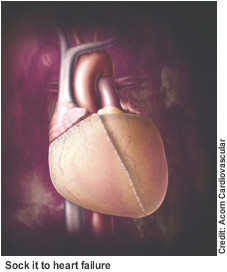
has applied the slimming hosiery principle to failing hearts. Their CorCap Cardiac
Support Device (CSD), a mesh wrap designed to gently support the heart, was put
to the test in clinical trials in 1999. Since then, over three hundred patients
have had it implanted. It's already been approved for sale in Europe, and applications
to the US Food and Drug Administration (FDA) and Canada are likely to follow.
So, what exactly is this 'heart stocking' supposed to do? Taking
its cue from the humble support stocking, a US firm called Acorn Cardiovascular
has applied the slimming hosiery principle to failing hearts. Their CorCap Cardiac
Support Device (CSD), a mesh wrap designed to gently support the heart, was put
to the test in clinical trials in 1999. Since then, over three hundred patients
have had it implanted. It's already been approved for sale in Europe, and applications
to the US Food and Drug Administration (FDA) and Canada are likely to follow.
So, what exactly is this 'heart stocking' supposed to do? IT'S
A WRAP
The CorCap CSD, which is made from polyethylene terepthalate
(PET) polyester, is the first therapy designed to address the heart's enlargement
since a complex investigational operation called dynamic cardiomyoplasty was done
10 years ago. Current therapies use drugs to alleviate
symptoms and slow heart failure progression, but the heart failure patient will
ultimately require a heart transplant. The CSD, however, aims to prevent and reverse
the progression of heart disease damage by providing end-diastolic support to
reduce mechanical stress, improve function, and prevent or reverse cardiac remodelling. The
Acorn Pivotal Trial, a prospective, randomized evaluation of the CorCap CSD in
patients with New York Heart Association (NYHA) class III to IV heart failure
began in June 2003. The study's promising results on 300 patients thus far were
recently presented at the American Heart Association meeting in New Orleans last
month. Research sites include institutions throughout
Europe and North America. The only Canadian site is headed by Dr Renzo Cecere
and Dr Nadia Giannetti at McGill's Royal Victoria Hospital Centre of Heart Failure
and Heart Transplant. This arm of the study includes 10 NYHA III patients with
dilated cardiomyopathy — five who received the CSD and five who did not.
Those who didn't get the device still received reparative surgery if it was needed.
Trial results show that, compared to the control group, the condition of patients
with the stocking improved (38% versus 27%), and the condition of those patients
who didn't receive the stocking worsened (37% versus 45%). There were significant
improvements in surgical necessity and quality of life. LONG-TERM
BENEFITS
The patients in the trial will be followed for another five
years. "The operation is not designed to provide an immediate benefit," explains
Dr Cecere. "Only over time does the device provide beneficial effects." Long-term
data is still needed to determine to what the extent the heart failure has been
reversed, the possibility of developing coronary artery disease, and whether a
theoretical restrictive/constrictive effect of the device on the heart after a
period of years is likely. So when will the CSD come
to gird the hearts of Canadian patients? Acorn marketing manager Karen Grota says
that though they don't have a timeline for submission to Health Canada for approval,
they are reviewing Canadian regulatory options. Dr Cecere thinks we're ready.
"There is enough data to show it's worthwhile to continue to pursue this," he
says. He thinks that if the final data proves the device's efficacy, Canadian
approval is likely. "We need other alternatives," he
says. "We need better drugs, artificial hearts, better devices that are cheaper
and easier to implant. Concepts like the Acorn device are relatively cheap, available,
and they can be sized to match patients, can be implanted in as little as 40 minutes
and the patient can go home two days later, able to expect improvement." TRANSPLANT
ALTERNATIVE
The doctor emphasizes that in terms of cardiac care we're
living in desperate times. "It may represent an alternative to a heart transplant.
That's the bottom line — that's what we're looking for with respect to heart
failure therapy. Some of these are young patients, in their 40s and 50s with potentially
a lot to contribute. Our objective is really to put them back into the community
and give them a good quality of life." Dr Cecere recalls
the days when dynamic cardiomyoplasty was their best hope. "It was a bizarre operation
where you'd take the latissimus dorsi muscle, detach it from the rib and vertebra,
swing it into the chest, and wrap it around the heart," he explains. The still-innervated
muscle was then attached via electrodes to a pacemaker to match its contractions
to the heart's. If the innervation was damaged during surgery, the simple fact
that the heart was 'wrapped' was found to still provide benefit to patients. "The
Acorn device is a very much simplified approach to dynamic cardiomyoplasty," he
adds.
|










