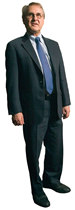
Dr Johann Koss joins the
fun at a Uganda refugee camp
Photo: Right to Play International
|
Can sport deliver children from
the horrors of sex slavery and war? Olympic speed skating
champ and physician Johann Olav Koss thinks it can.
His charity Right to Play works with kids in 24 war-torn
countries, building sports facilities from football
fields to basketball courts, and providing equipment
for the kids. They also provide counselling and life
skills training to the troubled kids. The goal is to
improve both the kids' mental and physical health. "Sport
is not a luxury," says Dr Koss. It's a tool for development,
helping kids grow and become active members of their
communities. "It's about children playing and being
children."
And it seems to be working. Take
the kids at Uganda's Imvepi refugee camp, a mix of former
child soldiers, sex slaves and war-displaced kids. Many
fled genocides in neighbouring Sudan and Rwanda, bearing
mental and physical scars too painful for any kid to
handle. There's the boy who was abducted by rebels and
trained to be a soldier. And the girl, also abducted
by a rebel group, forced to work as a sex slave. As
so often happens, she became pregnant and was cast out
by her community. She wrote to Dr Koss at Christmas
to tell him that after taking part in the Right to Play
program she was accepted back into her family and community.
"Seeing the change in these kids' lives is one of the
most rewarding aspects of the program," says Dr Koss,
head of Right to Play.
BLADES
OF GLORY
Dr Koss's involvement with Right to Play dates back
to his speed skating days, just before the 1994 Winter
Olympics in his native Norway. The charity was then
called Olympic Aid and enlisted athletes to raise awareness
for poverty in Africa. The Oslo med student travelled
to Eritrea and saw first hand the poor conditions that
the children lived in.
He returned home to compete in
the Olympics earning three gold medals
and donated a good portion of his prize money to the
charity he'd come to admire. The organization grew quickly
beyond its original scope. They restructured, moved
out from under the Olympic umbrella and became Right
to Play with Dr Koss at the helm in Toronto. So how
did a Norwegian doctor end up running an NGO in Canada?
"I married Belinda," Dr Koss says.
Yes, that Belinda Belinda Stronach. The
couple met in London in 1999 and married later that
same year. The marriage was short-lived they
divorced after three years but by then, Dr Koss
had fallen for his adopted country and decided to establish
the charity's headquarters in Toronto.
He then faced another tough choice.
"The focus you have to give medicine needs to be 100%,
and the focus to give to Right to Play needs to be 100%
also," says Dr Koss. "It was very hard to leave medicine,
but what I'm doing right now is a great alternative.
And my medical background has helped bring the health
aspect into this organization."
IT
TAKES A VILLAGE
Nowhere is this more apparent than at Imvepi, where
Right to Play has been working since 2002. With the
help of UN organizations like UNICEF and UNHCR, the
charity started educating kids about HIV and how to
protect themselves from the virus. They also teach them
problem-solving and other life skills for the future.
The sports part of the program
gives the boys an outlet for their aggression and the
girls a fresh respect for their bodies, says Dr Koss.
Many end up working for the charity. "They're looking
after other children and mentoring them."
But funding is a chronic problem.
And Dr Koss partly blames his adopted homeland. "Canada
made a commitment forty years ago to increase international
aid from 0.3% to 0.7% of the GNP," says Dr Koss. That
adds up to a hefty $175 billion. Unfortunately, although
Prime Minister Harper pledged to fulfill Lester B Pearson's
promise, no solid effort has been made. In fact, the
PM earned harsh criticism from U2's Bono and Ms Stronach
among others at June's G8 summit in Germany for reportedly
blocking an agreement to increase aid to Africa.
Still, there's hope, says Dr Koss.
With a little less focus on the politics, and a little
more focus on the humanitarian aspect, maybe a plan
will come about, he says.
In the meantime, he keeps up his
skating by strapping on his roller-blades "even
a former athlete needs to watch his weight," he jokes
and works at growing the charity so he can help
even more kids discover the healing power of sport.
|