|
"Like I gotta take de meds, right
doc?"
Some patients haven't got the
health literacy skills to follow your instructions.
More and longer hospital stays and less chance of a
cure
By Susan Usher
In the popular mind, today's
patient is a net-savvy researcher who arrives in your
office with a stack of literature about her condition
and a million questions to fit into a seven-minute visit.
True enough every doctor has a few patients who match
this description. But what about the others? You know
the others -- the "easy" ones who listen to you attentively
as you diagnose their ills and proffer advice but don't
talk much, who answer questions vaguely or with nods
and smiles. While they may take up little office time,
the truth is many of these patients don't have a clue
what they're supposed to do once they leave your office.
And their health could be suffering as a result.
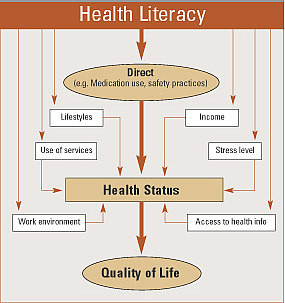 So
what makes a patient a health literate patient? The
American Medical Association defines health literacy
as "the ability to read and comprehend prescription
bottles, appointment slips and other essential health-related
materials required to successfully function as a patient."
Major studies in the US in the past two years have found
that patients with low health literacy are less likely
to understand their discharge diagnosis, reasons for
taking medications, instructions for taking medications,
plans for follow up tests and appointments, elements
of self care, or all of the above. They're hospitalized
at a higher rate -- and their chronic health conditions
are less often kept under control. So
what makes a patient a health literate patient? The
American Medical Association defines health literacy
as "the ability to read and comprehend prescription
bottles, appointment slips and other essential health-related
materials required to successfully function as a patient."
Major studies in the US in the past two years have found
that patients with low health literacy are less likely
to understand their discharge diagnosis, reasons for
taking medications, instructions for taking medications,
plans for follow up tests and appointments, elements
of self care, or all of the above. They're hospitalized
at a higher rate -- and their chronic health conditions
are less often kept under control.
CANADIAN
TRENDS
Canadian research on
literacy and health is scarce, but the problem is just
as pressing here. Surveys in the 1990s revealed shocking
levels of low functional literacy among Canadian adults.
A 1996 Statistics Canada survey found that one in five
Canadians had serious difficulty with printed material
generally, and one in four had trouble reading more
complicated material like labels on medications. Seniors,
who use health care most, are among the least literate.
The Canadian Public Health Association and Health Canada
have gone some way toward addressing the issue and,
slowly, isolated programs are starting to pop up across
the country.
Dr Linda Shohet is one person
working on the ground to improve patient information.
She directs the Health Literacy Project at the Montreal
General Hospital as a partnership between the hospital's
nursing department and the Centre for Literacy of Quebec,
of which she's executive director. The project has been
operating in three of the hospital's units -- dialysis,
oncology/hematology and the pre-operative centre --
to make staff more open to alternative ways of communicating
with patients and to arouse their interest in the reasons
why a patient may not be able to understand medical
instructions. While the effort has been well received,
especially by nurses, the hospital administrators have
been slow to implement changes to its policy. "None
of the MUHC hospitals even have a policy of what patient
information should look like," she says. "At the moment
everything is done unit by unit by people who have no
training in writing patient information."
BEYOND
THE THREE Rs
Dr Shohet believes
we need to explore different ways of communicating in
order to respond to individual patients and go beyond
the notion of reading ability in our considerations
of health literacy. "We need to consider why people
are having difficulty with communication," she says.
"It could be because they never learned to read and
write, but it could also be a learning disability, a
visual or hearing impairment, or a cognitive impairment."
There is currently no data
on the impact of different forms of information on patients
with limited literacy because these groups are effectively
excluded from research samples. "We don't know whether
audiotapes or videotapes work better than printed materials
because it's never been studied," says Dr Shohet. "There's
some evidence that people who don't read and write don't
take oral instructions very well either, perhaps because
they're missing a large amount of the vocabulary and
knowledge that readers have."
Dr Irving Rootman, of the
University of Victoria, is working to see these research
gaps filled so that strategies can be designed to improve
healthcare for less literate Canadians. In September
2003, he and Dr Barbara Ronson from the University of
Toronto reviewed past efforts in the area and set out
a research road map for the future. They recommended
that the Canadian Institute for Health Research (CIHR),
the Social Science and Humanities Research Council (SSHRC)
and the Canadian Health Services Research Foundation
(CHSRF) develop a joint initiative to fund both research
and capacity development, to find out what strategies
will work best to reduce health disparities based on
health literacy. In a promising step, the CIHR recognized
health literacy as a priority in its strategic plan
last year.
Next on Dr Rootman's list
is looking at health literacy in the context of physicians'
practices to find out how low it might be. He has received
CIHR funding to research measures of health literacy
that go beyond reading ability. Ensuring understanding
and promoting health literacy is just as much the responsibility
of the system as it is the individual's, Dr Rootman
believes. "Health care systems need to provide individuals
with support no matter what their literacy levels."
For more information on
the Health Literacy Project, visit www.nald.ca/PROVINCE/QUE/litcent/health/healthlt.htm
|









