
 "What
is the Truth? Where is the line between imagination and
reality? Who can say that the mad do not see into realms
forbidden to the sane?" These are the kinds of challenges
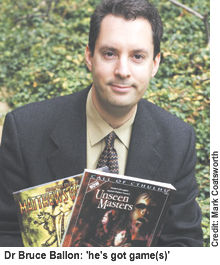
36-year-old psychiatrist Dr Bruce Ballon throws at players
of his role playing game (RPG), Unseen Masters.
In designing the award-winning game, Dr Ballon drew from
his two passions: medical science and the arts. "What
is the Truth? Where is the line between imagination and
reality? Who can say that the mad do not see into realms
forbidden to the sane?" These are the kinds of challenges
36-year-old psychiatrist Dr Bruce Ballon throws at players
of his role playing game (RPG), Unseen Masters.
In designing the award-winning game, Dr Ballon drew from
his two passions: medical science and the arts.
RPGs are fantasy games with a progressive
storyline in which players adopt characters who act
out (usually verbally) a series of dice-driven adventures
(Dungeons and Dragons is the most famous RPG).
Unseen Masters' 216-page scenario is set in a
gothic, crime-infested urban dystopia; Dr Ballon has
made good use of his training and filled the text with
psychiatric lore. It includes a detailed guide to simulating
psychotic symptoms as well as descriptions of the effects
of various psychoactive drugs, including ketamine, cannabis
and phencyclidine. There's also information on post-traumatic
stress disorder, a study of the "psychodynamics of vampirism,"
considerable sociological background on the described
illnesses and information on how to get proper treatment
for each.
Dr Ballon's fascination with fictional
portrayals of madness goes back to his childhood in
Winnipeg, where he spent many a dark, cold, windy night
reading the classic horror stories of Edgar Allan Poe,
Charles Dickens, Nikolai Gogol and HP Lovecraft. "In
the late 19th and early 20th century, horror was part
of high culture, considered upper class stuff," says
Dr Ballon. "In the last hundred years it's gotten a
bad rep, because there's a lot of schlock, less of the
deep psychological themes you saw in the classics."
He earned a small victory for the maligned genre when
his own Poe-influenced horror story took first prize
in a grade-12 literary competition. But it would be
years before the doctor began to take his literary talents
seriously.
In his role as addiction education
coordinator for U of T, and consultant psychiatrist
for the Youth Addiction, Problem Gambling and Concurrent
Disorders Services at Toronto's Centre for Addiction
and Mental Health, Dr Ballon helps youth escape the
clutches of mental illness. In his spare time, he devotes
his energies to helping the sane peek into the forbidden
realms of addiction, schizophrenia and psychosis through
media ranging from film and television to literature
and the increasingly popular RPGs.
HOW
THE DIE WAS CAST
An avid RPG player since he bought his first Dungeons
and Dragons game at Zeller's in the 80s, Dr Ballon
decided a few years ago that it would be an amusing
challenge to come up with his own. It struck him that
the interactivity of the genre -- in which players are
given detailed outlines for acting out complex situational
dramas -- provided an ideal platform for exploring the
relationship between horror and mental illness that
had long fascinated him. In 2001, after several months
of drafting, Unseen Masters was released by established
RPG publisher Chaosium.
Unseen Masters won the 2001
Mary Seeman Award for Outstanding Achievement in the
Area of Psychiatry and Humanities, and Chaosium took
Dr Ballon on as a psychiatric consultant. He followed
up in 2003 with another RPG, titled From the Files
of Matthews Gentech, a study of schizophrenia and
genetic manipulation framed in a modern Frankenstein
tale, featuring a mad biologist and his army of metahuman
abominations. With terrifying psychological detail that,
as one critic put it, "could very well convince you
you're trapped in a nightmare," this work earned the
doc another round of award nominations.
HOT
COMMODITY
It didn't take long for word of Dr Ballon's expertise
on mental illness to spread to other corners of the
entertainment industry. Two years ago, the producers
of TV Ontario's Planet Parent signed him on as
a psychiatric medical  consultant.
Then the producers of the popular program DeGrassi:
The Next Generation hired him to instruct an actor
on how to portray bipolar syndrome. This year, Hollywood
came knocking. He was summoned to the Toronto set of
the remake of John Carpenter's 1970s crime classic Assault
on Precinct 13 to coach actor John Leguizamo on
how to portray a realistic methamphetamine addict. consultant.
Then the producers of the popular program DeGrassi:
The Next Generation hired him to instruct an actor
on how to portray bipolar syndrome. This year, Hollywood
came knocking. He was summoned to the Toronto set of
the remake of John Carpenter's 1970s crime classic Assault
on Precinct 13 to coach actor John Leguizamo on
how to portray a realistic methamphetamine addict.
Dr Ballon believes producers who
seek out expert psychiatric opinion are making important
inroads toward a fairer depiction of mental illness
on screen. "There are a lot of stereotypes out there,
especially when you're dealing with addiction issues,
which are often portrayed as moral problems rather than
medical ones," he says. "I like to think I'm involved
in a kind of anti-stigma campaign."
HIGHBROW
LEANINGS
Dr Ballon's interest in the arts goes far deeper than
gaming or show business. He's fascinated with the ways
art can influence the discipline of psychiatry. For
several years, he has been on the board of directors
of the Workman Theatre Project at the Centre for Addiction
and Mental Health, which helps patients to build self-confidence
and combat stigma by putting on live performances, film
festivals and art shows for the public. He also created
a film group for youth with anxiety disorders at the
Hospital for Sick Children, guiding them through the
process of filmmaking from the storyboard through post-production.
As an assistant professor of psychiatry
at the University of Toronto School of Medicine, Dr
Ballon also encourages his students to take an active
interest in the humanities. "A lot of them have different
interests that they're afraid to pursue because they
think these ideas aren't academic enough," he says.
"They think it's all about drug trials and basic research,
but I want them to consider how psychiatry connects
to the humanities, its history, its portrayal in film."
Dr Ballon even encouraged one of his young charges to
pursue her esoteric fascination with the legends of
the influence of the full moon on outbreaks of mental
illness -- this led to her giving an enthusiastically
received Grand Rounds presentation. Dr Ballon's unorthodox
approach hasn't escaped the attention of the establishment:
this year he received the prestigious AAP/Forest Junior
Faculty Development Award from the Association of Academic
Psychiatry.
Meanwhile, his primary work with
young substance abusers and gambling addicts continues
to fuel Dr Ballon's creative drive. He's currently at
work on an RPG that will delve deep into the experience
of addiction. Players' characters will undergo deterioration
in their ability to communicate, to concentrate, to
interact socially, even to wake up, and they will spend
much of the game seeking out whatever substance they
are dependent upon. Several game publishers are interested
already. Keep an eye out for this ambitious project,
whose working title is In Vino Veritas (There
is truth in wine).
|










