
 "Volitional,
proactive anorexia is not a disease or a disorder. There
are no VICTIMS here. It is a lifestyle choice. If we ever
completely tapped that potential in our midst, and applied
it to other areas we could change the world. Completely.
Is THAT what they are so afraid of? Is THAT why they strive
so eagerly to silence our voices? (Ana's Underground Grotto) "Volitional,
proactive anorexia is not a disease or a disorder. There
are no VICTIMS here. It is a lifestyle choice. If we ever
completely tapped that potential in our midst, and applied
it to other areas we could change the world. Completely.
Is THAT what they are so afraid of? Is THAT why they strive
so eagerly to silence our voices? (Ana's Underground Grotto)
This is an excerpt from a popular
"pro-ana" (pro-anorexic) and "pro-mia" (pro-bulimia)
website, part of what those who treat patients with
eating disorders consider a sinister internet cabal.
Pro-ana and pro-mia people view their eating disorders
not as illnesses, but as ways of life. While websites
like this one ? a strange cross between a teen fan site
(complete with multicoloured text, smiley faces, and
an over-fondness for exclamation points) and conspiracy
theory ? are easy to dismiss as mere adolescent internet
weirdness, they are more than paranoia and bad poetry.
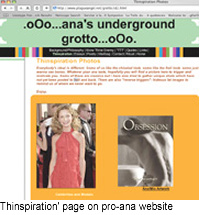
THINSPIRATION
Pro-anas and pro-mias use their websites to teach each
other to better pursue their diseases. The website quoted
above contains a list of "rules" for eating in restaurants
("Eat a tossed or garden salad appetizer, only 20-30
calories and helps fill you up before the entree arrives")
and tips on how to fool family, friends, and therapists
about how much they ate and how to sidestep their coaxing
("Well, I had a really HUGE breakfast and I'm still
full from that").
There are also practical tips for
bulimics: "Tie your hair back before purging. Having
puke in your hair can be an obvious sign to others of
what you were just doing." (Fragile Innocence). Most
of the sites feature "Thinspiration" sections, with
photos of thin actresses like Ally McBeal's Calista
Flockhart and models like Kate Moss to act as "triggers"
? pro-ana/pro-mia parlance for inspiration.
EATING
DISORDER FACTS
According to the Canadian Mental Health Association
(CMHA), anorexia affects 1% to 2% of Canadian women
between the ages of 15 and 25, and bulimia affects between
3% and 5% of Canadian women in this age group ? that
adds up to over 85,000 sufferers in Ontario alone. Ten
percent to 20% of eating disorder sufferers will die
of their diseases; anorexia has a higher mortality rate
than bulimia. How do these sites affect the treatment
of these patients?
"When someone's internally ready,
I think that they can move beyond it," says Ms Lauren
Goldhamer, an eating disorders specialist at Bellwood
Health Services in Toronto, a clinic that treats eating
disorders and addictions. "But when they're not, these
sites give even more ammunition to the patient. They
learn the lingo of therapy. They learn what to avoid,
how to not trust, how to stay distant, how to keep their
weight down, even in a clinical setting."
|

A quarter century of purging:
the 25th anniversary of bulimia nervosa
In the 1970s, Dr Gerald Russell
of the Institute of Psychiatry at the University
of London, was treating psychiatric patients at
London's Royal Free Hospital. He was puzzled by
a subgroup of anorexics who lost little weight,
but compulsively overate, then induced vomiting.
He published a paper in August 1979 in Psychological
Medicine, naming this new condition bulimia
nervosa, an ominous variant on anorexia nervosa.
This year marks the 25th anniversary
of this first description of the disorder, and
in European Eating Disorders Review Dr
Russell revisits his discovery. He looks back
over the past quarter century of bulimia research
and his conclusions offer a ray of hope: "My view
about the ominous nature of bulimia nervosa,"
he writes, "was unduly pessimistic."
|
THERAPISTS'
VIEW
Karin Davis, program coordinator of the National Eating
Disorder Information Centre, agrees. "The main thing
is that they are encouraging people to stay sick," she
says. "They're not encouraging people to go into recovery,
to look for ways of getting help." As the movement gained
notoriety in the past few years, many groups, including
the National Eating Disorders Association, began calling
for censorship. Some internet service providers and
hosts, like Yahoo!, have responded and now refuse to
carry pro-ana/pro-mia sites. The move has sparked outrage
and a spate of petitions from "pro-choice" anorexics
and bulimics, who claim their freedom of expression
is being suppressed.
Despite all the brouhaha, the crackdown
doesn't seem to be making the problem go away, but rather
it's sending many of the sites further underground;
some now screen members and require passwords and usernames,
and many pro-ana/pro-mia links listed on sites are now
broken. Though some pro-anas turn their backs on their
eating disorders ("I am no longer involved in this or
any other pro-ana site, I have gone into recovery...
at 45kg it still wasn't good enough for me... Sooner
or later we recover or we die, it's your choice" ? Perfecting
Ana), most of the pro-ana/pro-mia webmistresses remain
defiant ("This is a place for the elite" ? Ana's Underground
Grotto).
SEVERING
TRUST?
While she believes these sites are "a dark force," Ms
Goldhamer believes that censorship can also be dangerous.
"It further severs the trust." Ms Davis is also unsure
about the way the backlash is being carried out. "Is
this actually pushing the people who are involved in
these sites further away from treatment and support
and from the professionals who are trying to reach out
to these individuals?" she wonders. "We don't know.
I think more research has to be done. I'm not sure censorship
is the right way to go." But she points out that pro-mia/pro-ana
websites do have something positive to contribute: "They
can show you a great deal about what is going on in
the mind of an individual who's struggling with this
illness."
|










